Who Murdered Balzac?
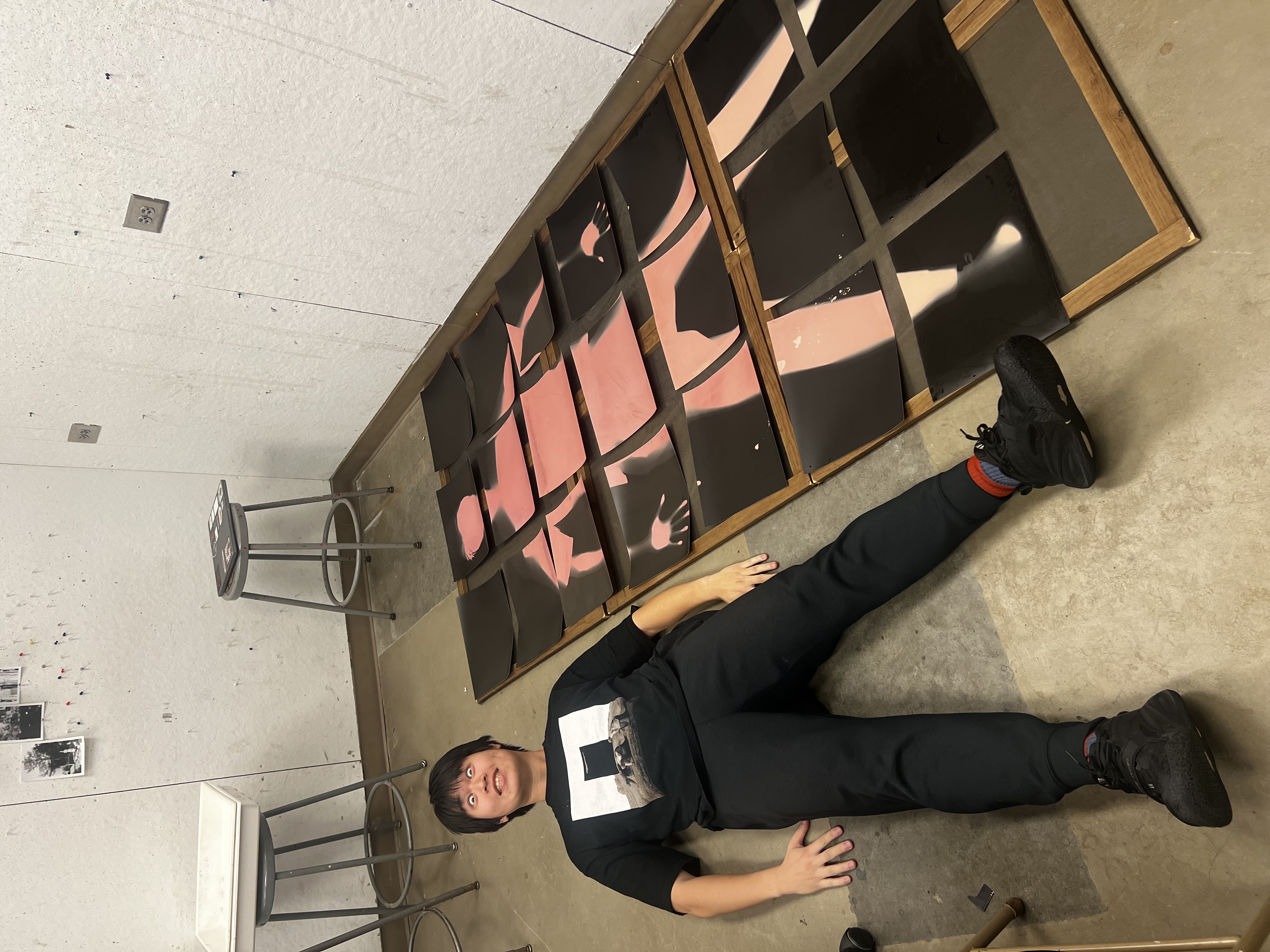
“Who Killed Balzac?” is an installation-based photography project located in Room 106 of the Visual Arts Building at Emory University. The work consists of a life-sized photogram made from my own body, installed inside the darkroom.
It was probably because I made no concrete plan for final exams during those few days wandering in New York that, upon returning to Atlanta, a violent wind of anxiety began to blow through my mind, scattering the room I had carefully constructed with reason. On top of that, the early December wind in New York had left me coughing for the entire break—the wind outside blowing inward, the wind inside blowing outward.
What perfect coordination from within and without -- Finals hadn’t even fully arrived, and I was already physically and mentally exhausted.
The final project for photography was approaching. Having survived last semester, I knew it would be the most time-consuming of all my finals (four credits, after all). Beyond photography, there were essays to write, exams I hadn’t reviewed for, presentations I had forgotten to prepare. If I were to spend hours in the darkroom at this moment, it would probably be to hide in the shadows and howl in pain.
Even so, I didn’t want to waste this opportunity—this legitimate, unavoidable chance to devote myself entirely to making something. I didn’t want to casually produce a few decent images and pin them neatly to the wall as a “complete” final project. Not only would my professor likely reject that (his standards seem to rise each week), I would also feel guilty for wasting the hundred-plus dollars I had spent on darkroom fees over the semester.
I agonized for a long time about what to do. My initial idea was to combine everything I had learned this semester and print twenty photographs—replacing quality with quantity. It was workable, but I couldn’t accept mediocrity as my ending. Despite thinking about it for half a month, I had no convincing project.
Until my second visit to Museum of Modern Art.
On the third floor, in the innermost gallery on the north side, hung a massive square painting—about two meters across. On it were several abstract human-like shapes. Because the painting was enormous and positioned along the exit passage, those sudden humanoid forms struck me with unexpected pressure—like walking cautiously through a cave with a flashlight and suddenly illuminating a gigantic mural lunging toward you.
Seeing that painting, I realized something:
I had never made anything physically large.
And then I knew what I had to do.
---
In my comparative literature class, I had read two texts.
The first was The Legend of a Daguerreotypist. In it, a daguerreotypist photographs a gentleman over and over. When he finally produces the perfect image, the gentleman seated before the lens disappears—his body gone, only his voice remaining.
The story captures early photography’s destabilizing power. When it was first invented, it felt revolutionary and terrifying. People believed photography was a form of sorcery: the shutter rises and falls, and a person is trapped inside an image—as if their soul were extracted.
The second text was written by Nadar, recounting how Honoré de Balzac feared photography. Like many of his contemporaries, Balzac distrusted the new medium. But as a cultured intellectual, he needed a rational explanation for his fear.
He argued that human existence is composed of countless infinitesimal moments layered together continuously. Photography, by isolating one moment, forcibly tears it away from that continuity and fixes it as an image.
(Nadar famously photographed Balzac—and later mocked him, suggesting that if his theory were true, he should take more pictures, given the size of his belly.)
---
Later, I wrote a paper analyzing these texts, exploring photography’s relation to what I called “The Extraction of Existence.”
It occurred to me that instead of writing about this extraction, I could perform it—using photography itself as the medium. Original broth, original ingredients.
Through the photogram process, I could print objects at a one-to-one scale directly onto light-sensitive paper. Compared to using a camera, this method is more immediate, more literal, and capable of preserving enormous detail. A 35mm negative is only 35 millimeters wide. A photogram, however, can be as large as the paper—and the paper can be enormous.
So I decided to use myself—my entire body—as the object that blocks the light.
---
In the darkroom, I normally use A4 paper and a small bulb. That wouldn’t suffice.
If I were transformed into a fish of equal size, finding a cutting board large enough to disassemble me would be difficult. But there are bigger fish in this world. How are they handled?
On-site execution, I thought. Perfect.
I applied for a full box of large-format paper. Late at night, when the building was empty, P and I entered the darkroom. We laid the sheets evenly across the floor. I lay down on them. The floor was cold. The paper was slick. Afraid of disturbing the white bed I had constructed, I treated myself like raw fish, waiting for the surgical light to strike my face.
Three.
Two.
One.
P turned on the lights.
My pupils could not endure the sudden brightness. Something exploded.
One.
Two.
Three.
Four.
The lights went off.
That thing did not recover.
Four seconds.
In those four seconds, I thought of Wade’s execution in The Three-Body Problem—a concentrated beam of energy striking his body. When the light vanished, so did he.
I also thought of my ending in Cyberpunk 2077. In that world, I lay on a bed beneath blinding light. My consciousness was about to be copied, converted into 0s and 1s, uploaded into a system to live on virtually. The new version would survive—perhaps for a very long time. But the original would certainly die.
So which one is this work?
The self under the light? Or the self after the light?
Even if I mock Balzac’s belly, perhaps his theory was not entirely foolish.
---
P and I developed the sheets one by one.
Pointing to a section, I joked:
“This is my left shoulder and upper arm. Now I understand dismemberment.”
After several hours, I carried a bag of my own body parts back into the light.
Because I did not fix the prints, the white portions gradually turn red under exposure—eerily corpse-like.
---
I wrestled with the title throughout the process. At first I wanted to call it The Extraction of Existence, letting the essay and the project echo each other. But the phrase felt pretentious.
My hair blocked more light, while my neck allowed more in. The head appears triangular—like E.T., or a palm tree stripped of leaves after a storm. I considered titles like “Alien Arrival” or “Palm After the Storm,” but they felt literal and foolish.
After adding black eyes, the figure became unsettling—reminiscent of the undead in the Rusty Lake series. I considered Corrupted Soul, but it felt too blunt, too horror-film shallow.
Then I returned to Balzac.
He would have feared this process. If photography ruptures the continuity of existence, if light extracts and kills, then the cold darkroom floor must resemble an operating table, a butcher’s block.
What kind of death is this?
If one frame of his existence is extracted and rendered at full scale, does this photogram become his corpse?
---
Finally, I stitched the twenty-one fragments together with tape. I heard echoes—from Frankenstein to Shimada Soji’s The Tokyo Zodiac Murders. I felt one step closer to being either a scientist—or a serial killer.
I hid the assembled body in the unlit darkroom. Whenever I sit there loading film, I feel as though I am inside a luxurious coffin. Now the coffin has a more fitting occupant.
In this murder—painless, almost clinical—I was the executioner. Perhaps P was. Perhaps the light itself.
In me, Balzac was killed—locked inside this lightless room, waiting for a professor or a student to open the door and feel either horror or relief.
This is my hidden-body case.
Like a murderer returning to the crime scene, I came back the next day and wrote on the door:
“Who Murdered Balzac?”