While working on my photography honors thesis, I came to realize that anyone who seriously practices and reflects on photography will inevitably construct a photographic ontology of their own.
Approaching this question from a more postmodern perspective—from Hiroshi Sugimoto’s long-exposure photographs of movie theaters and Thomas Ruff’s digitally generated images to photographic practices that appropriate imagery from Google Earth—the screen emerges as a photographic subject that can no longer be ignored.
Yet photographing a screen in the conventional sense still preserves the separation between two distinct media: the screen displays and emits light, while a camera captures the image from outside. Beyond the screen, there always remains another camera serving as the recording device.
Traditional screenshots, however, move toward the opposite extreme. Although they generate images directly from within the screen, they lack one of photography’s most essential qualities: temporality.
To expand the possibilities of photography taking place entirely within the screen, and to extend our exploration of the boundaries of the photographic medium, I developed Stiller.
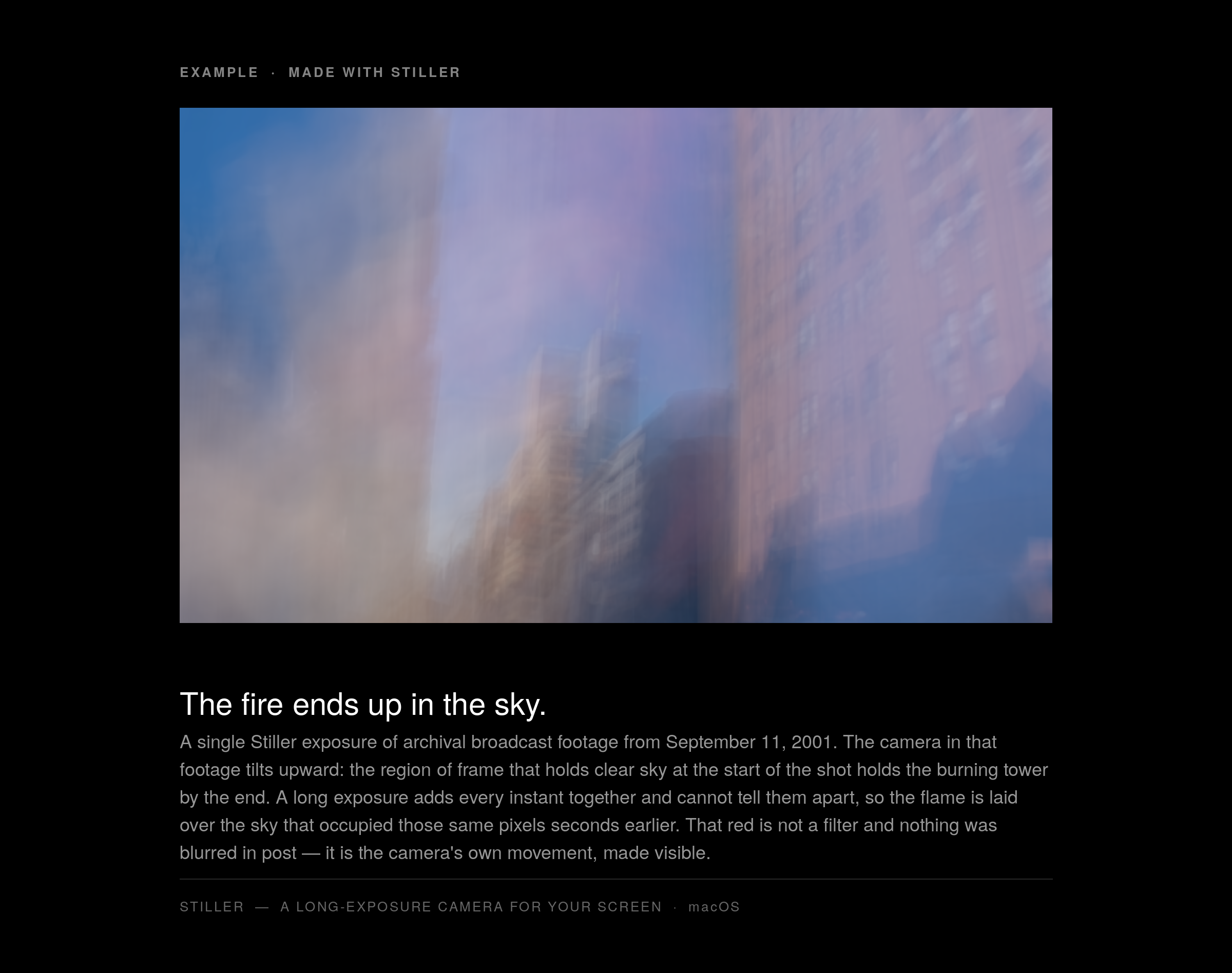
With Stiller, users can control the brightness of their computer screen, select a specific area, and apply various forms of exposure to both moving and still images within that area.
Because this photographic process is built upon an entirely non-physical structure, it can also produce effects that would be impossible in conventional photography—such as images becoming darker the longer they are exposed, or exposure accumulating slowly at first and then accelerating.