Yesterday I went to the Plaza Theatre to see the experimental installation film Line Describing a Cone.
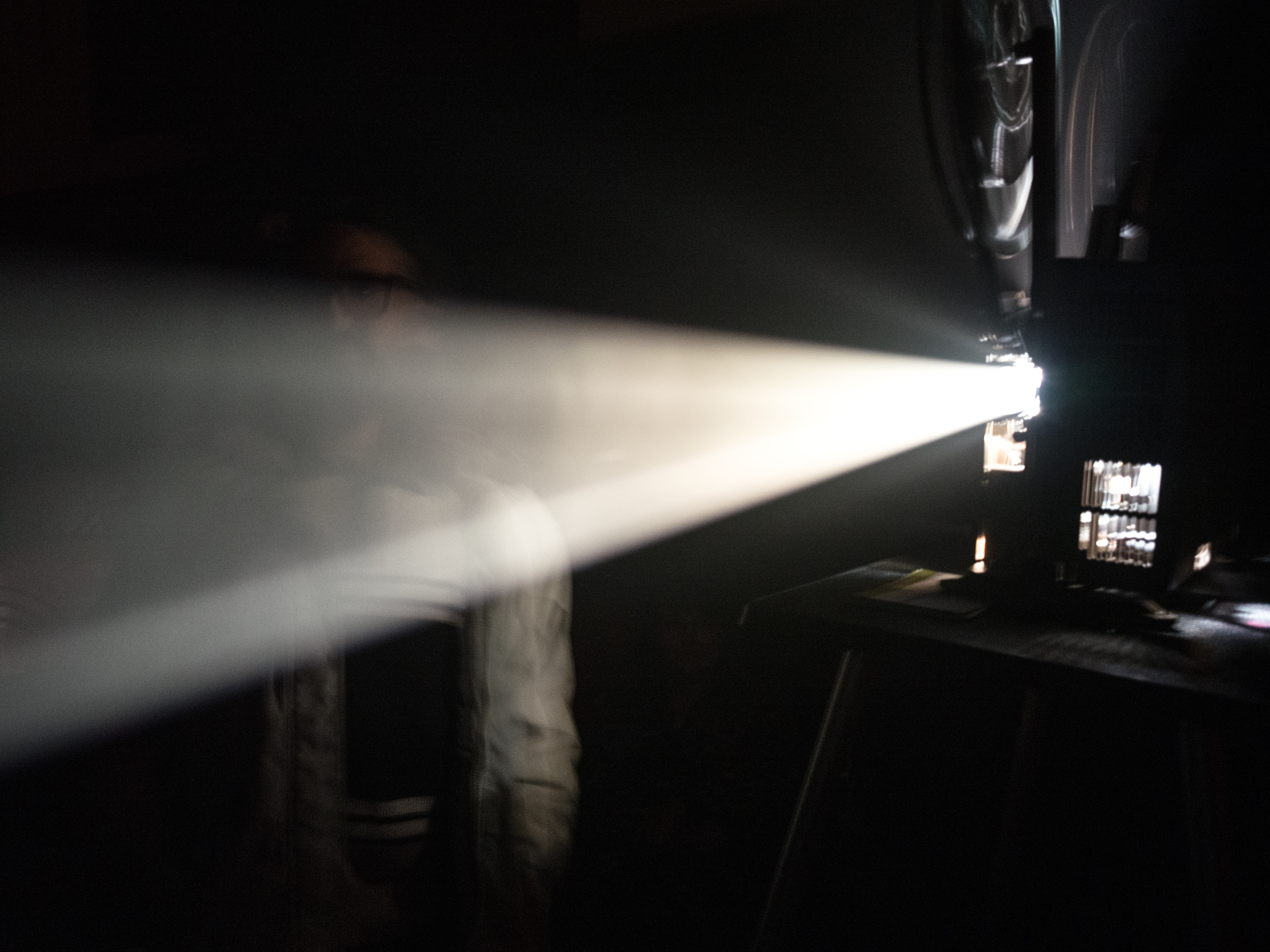
Its essence is radically simple: a projector casts a thin beam of light that gradually extends and moves along a circular trajectory onto a distant screen. When the room fills with smoke, this two-dimensional projection, through the medium of haze, transforms into a three-dimensional cone of light suspended across the center of the space.
The work sparked several reflections for me:
1. Light, Not Illusion
Unlike what we call “holograms,” the focus of this piece is light itself—not the reflective medium (the smoke) that makes it visible. I tried blowing into the beam, expecting some reaction, but nothing happened. The image remained indifferent. That indifference was strangely counterintuitive. We are used to screens responding to touch; here, light simply persists.
2. Visibility Without Sensation
The installation carries a strong interactive temptation. People feel an irresistible urge to reach into the cone. The desire resembles the childhood impulse to cover a flashlight with your palm, or perhaps something deeper—our innate attraction to light.
Yet touching the beam produces no tactile feedback at all—unless you move close enough to the projector to feel its heat. It is visible, immersive, almost sculptural, yet physically intangible. In an era saturated with touchscreens and haptic feedback, we are accustomed to the “visible but untouchable.” But as a work created in 1973, this was radical. Even today, I find it astonishing.
3. Projection, Power, and Position
This is a monumental form emerging from a single source. Dozens of people gather in a dark room, circling a beam that originates from one end and expands gradually as it travels toward the screen at the other.
It was impossible for me not to perceive this as a political experiment disguised as formal minimalism.
At one point, I stood directly in front of the projector and placed my hand in the newborn beam. Instantly, the entire cone disappeared for everyone behind me. I held the greatest power in the room: I could deny vision to all. And yet, from that position, I could not properly observe the cone myself. I possessed control, but lost the privilege of viewing.
Later, I moved to the far end of the room. From there, the cone appears at its most complete—a luminous tunnel stretching from source to surface. This is theoretically the optimal viewing position. Yet it is also the most fragile. Anyone closer to the projector can block the beam and dismantle my entire field of vision.
The relationship between position and power turns the work into something beyond pure formal beauty. It becomes a fluid social experiment—about obstruction, hierarchy, dependence, and collective vulnerability.