April 25, Before Dawn
Late at night on April 24, 2024, I stacked two pillows together and prepared to plunge my head into them. As always, my brain began replaying everything it had absorbed that day. All day long I had been scrolling through footage of protests at Columbia University and New York University. When everything finally quieted down at night, those images grew louder instead, noisy enough to irritate me.
I thought of Monday morning—April 22—when “Free Palestine” had been sprayed onto the wall of our campus museum, only to be hastily covered that afternoon with kraft paper and blue tape. Every time I walked past those two sagging sheets of paper, I felt a vague sense of the calm before the storm. And whenever I considered the makeup of our school, I felt this could never really blow up: the president is Jewish; the school is in the South; it’s private; it’s small; most students come from affluent families… however I turned it over in my head, this did not feel like a place built for upheaval.
Yet during those long minutes with my head buried in the pillow, unable to fall asleep, I became increasingly convinced that the fire ignited on the East and West Coasts would spread inward—into the Midwest, into the South—and eventually burn its way into every campus.
On the morning of April 25—today—I was jolted awake by WeChat messages. Still half-asleep, I saw videos my friends had sent: tents scattered across the ground, police in uniform. I sprang out of bed, grabbed my two cameras—one slung across my chest, one over my shoulder—washed up hastily in five minutes, and crashed out the door, straight for the main lawn.
By the time I arrived, most of the tents were already gone. The lawn had long been cordoned off with yellow tape, supposedly for reseeding new grass—no entry allowed. One couldn’t help but suspect a quieter intention: preventing students from gathering to protest. Even so, during the hours I had been asleep, dense clusters of tents had once stood here. Now only traces remained—bags, food, scattered debris, a scene of disarray. Along the edge of the lawn stood police from different agencies, dressed in blues and greens of varying shades. Students gathered outside the perimeter, craning their necks to look in. I hunched over protectively, shielding my cameras, and slipped inside.
Apart from the police, there was little else to see. My nose and eyes stung faintly. A friend told me the protest had already ended—police had used tear spray just minutes earlier. Several students and professors had been taken away, including the chair of our philosophy department, Noëlle McAfee.
According to my friends, McAfee is a white-haired elderly woman who speaks gently and softly; it was hard for anyone to imagine her being arrested. Later, I saw the video on Twitter: she offered no resistance, still speaking softly to the camera as she followed the police step by step. The clip quickly amassed tens of thousands of retweets. They also told me that earlier, a student had been pinned to the ground and tased in the thigh—another video that rapidly gained attention online.
The zip ties hanging from the backs of the police officers glinted in the sunlight, reminding me of the times I’d played Ready or Not, where suspects are routinely bound with plastic restraints. But when I saw the real-life counterparts of the characters I’d once played—smiling, striding briskly past me—I felt only fear.
Hearing shouts from afar and watching the police in front of me begin moving in groups toward the sound, I realized the “main battlefield” had shifted. I followed quickly. A mass of people crowded onto a stone path, holding up phones, cameras, protest signs.
The outermost ring was, unsurprisingly, made up of onlookers eager for spectacle, doing everything they could to secure higher ground for a better view.
I pushed into the crowd and encountered a scene far more intense than I had anticipated: students, professors, and police facing off at close range; arms raised high with phones; fists pumping in time with shouted slogans.
A dull thud echoed in the distance. The crowd grew more agitated. I heard people yelling, felt the police surge forward. Catching sight of the yellow rifles in their hands, I realized the sound was rubber bullets. I watched a man with green hair spit at the police; instantly, more than a dozen officers swarmed him, pinned him down, and cuffed him.
It was my first time standing inside a protest crowd. My first time seeing tasers and rubber bullets pressed against human bodies. My first time witnessing collective police enforcement up close. My initial reaction was uncontrollable panic—I was terrified they would fire into us. I clenched my camera and prepared to retreat. But when I saw the journalists to my right—faces calm, expressions steady—I found a sliver of resolve and edged closer to them.
One thing I love about photography is this: the moment I lift the camera, I gain the power to objectify the world. I am granted a courage and curiosity I don’t normally possess. My photography professor Jason once told me, When you’re holding a camera, you can do many things you usually can’t. That sentence has stayed with me.
After the first wave of fear passed, I felt strangely calm. I decided to move straight to the front, face-to-face with the police. I held my camera. I did not chant. My face remained neutral. I knew that as long as I didn’t cross a line, I would be fine. And indeed, even as people beside me were taken away, I kept pressing the shutter.
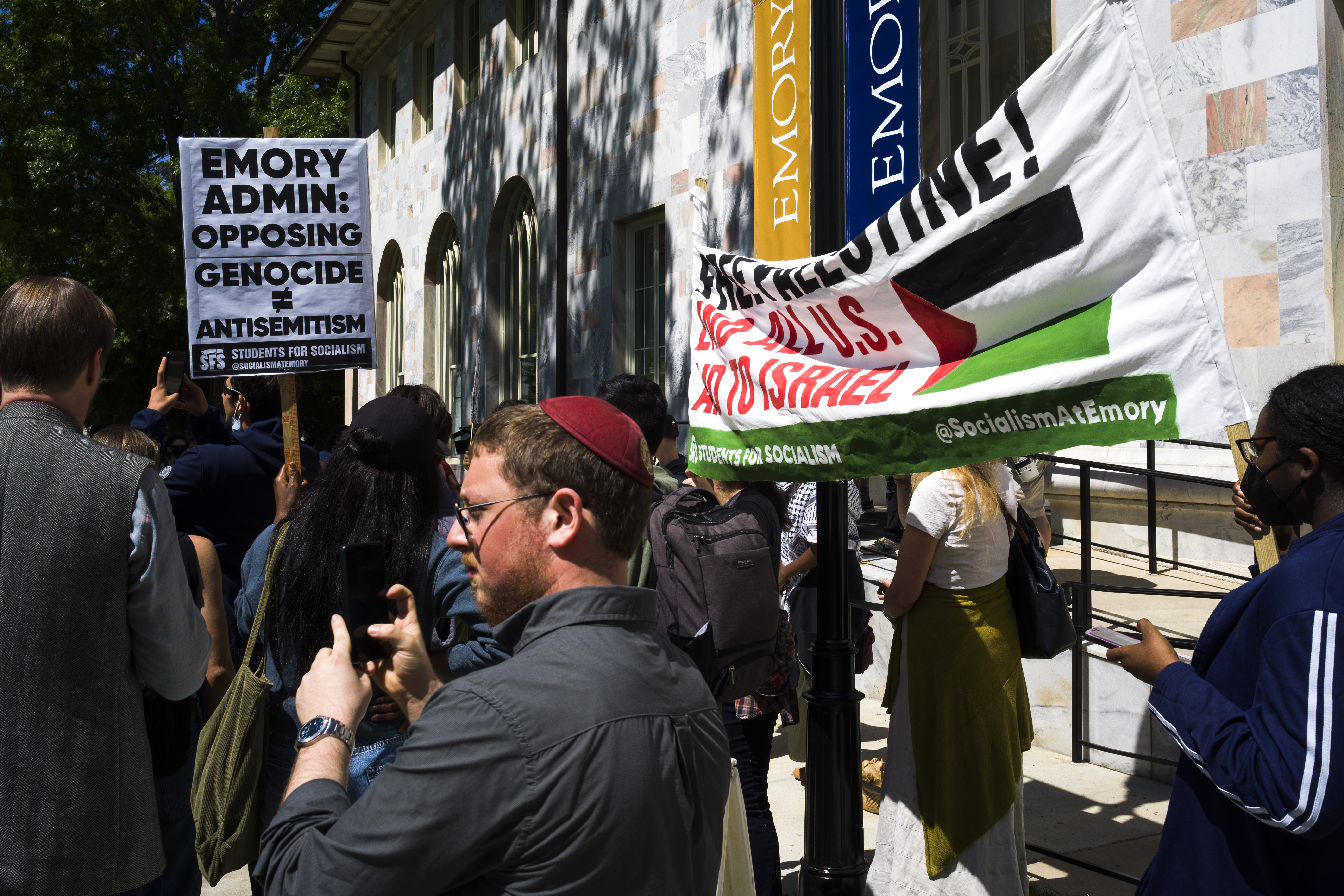
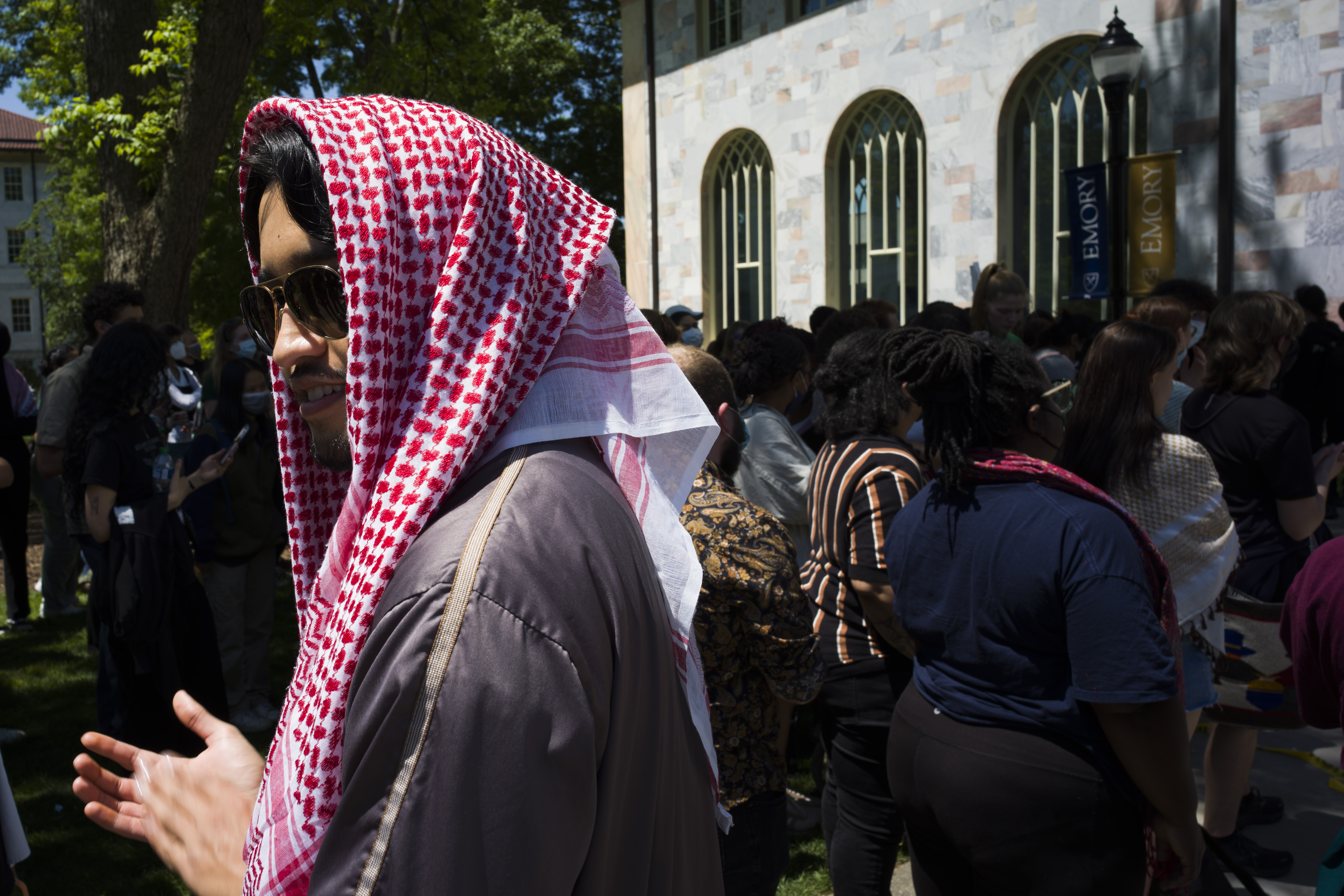
The crowd was remarkably diverse: white, Black, Asian, Muslim, even some Jewish participants—all facing the same direction, shouting the same slogan. Each time someone was pinned down, zip-tied, and led away, the crowd erupted in synchronized shouts:
SHAME! SHAME! SHAME!
My eyes had never seen a scene like this; my skull had never felt such resonance. I was suddenly reminded of the cinema screening Oppenheimer, where the audience stomped in unison, releasing a shared emotion, deafening in its force. I felt short of breath, as if I had to shout along with them.
After about half an hour, several organizers decided to move the crowd—perhaps a kind of guerrilla tactic. We looped back to the original lawn, now devoid of police. Most officers had left to escort the twenty-some arrested students and professors, departing in over twenty police vehicles from various departments. The scale of it was unprecedented for me.
What struck me as darkly humorous was seeing three or five Jewish men standing on the lawn, wearing round skullcaps, arguing face-to-face with protesters. No one resorted to violence—at least the bottom line held. They hurled provocative remarks from behind the protesters, but nothing more.
I noticed a mother playing with her children at the edge of the crowd and asked if I could take a few photos. She welcomed it. I didn’t ask why she’d brought her children to something like this—was this cultural, somehow? Not long after, the two kids answered my unasked question through action: they lay down one after another and traced the outlines of their bodies on the ground, representing dead children—or so I interpreted it. Perhaps they were simply playing.
I pushed toward the very center, the very front, and kept shooting. I felt a disturbing thrill—like tasting a blood-soaked bun—an objectifying cruelty toward others. I began to understand what people mean by “journalistic ethics.” I exchanged a few words with the reporters beside me, cameras and microphones hoisted. It was my first time sharing a “battlefield” with professionals, and I wanted to satisfy my curiosity through conversation.
My professor Jason—a Jewish man—walked toward me from a distance. He asked if I had taken photos.
“I’ve taken three hundred,” I said.
“Good,” he replied, and walked off to speak with other professors.
So I kept shooting.
The chanting continued. The crowd grew denser. My camera battery dwindled. After two and a half hours, I left.
On my way out, I passed the museum again. People who had torn down the paper coverings walked past me. The slogans on the wall could not be washed away. My mind was a knot of unresolved thoughts.
From beginning to end, I never took a side. I never shouted. I held a camera. I captured light that makes no moral distinction. I need several more nights to think through this struggle—this force, this system—to untangle the games of power behind it, the attribution of guilt, the meaning of raised fists—and my own position within the conflict.
Continuation
Over the past two days, the protests have only grown louder. The lawn fills with more people; the voices swell. Yet to me, the nature of the movement has already shifted, branching into something far more diverse.
First, a change in power. President Gregory L. Fenves, Jewish himself, has been dragged mercilessly by students and faculty alike. He has not appeared once, only sending out an email. His dual identity—president and Jew—made him the unanimous source blamed for calling in the police on April 25. Across campus, flyers and graffiti reading “Fuck Fenves” and “Fire Fenves” appeared everywhere.
On the first day of the protest, Fenves emailed the entire school, claiming those pitching tents on the lawn were outsiders—external forces—and that police intervention was necessary to ensure campus safety.
But once the chair of the philosophy department had been arrested, that rationale collapsed into a clumsy, all-purpose excuse. Add to that the fact that the twenty-eight arrested students and faculty were charged with vague offenses like endangering public safety or disorderly conduct, and Americans truly got a taste of something new. I couldn’t help thinking: every American bookstore stocks at least three copies of The Art of War. Wasn’t all of this, in its own way, a form of cultural export? Ha.
Meanwhile, faculty voted collectively to hold a no-confidence vote against the president next Wednesday. I doubt this decision stems solely from this incident; it merely ignited long-simmering anger.
During my year at this school, I’ve often heard professors complain about the current administration: an obsession with STEM at the expense of the humanities; inequitable budget allocation; shrinking funds for travel and programming; rigid curricular requirements limiting academic freedom.
My photography professor Jason once complained in class, Can you believe it? Universities don’t even require students to read Aristotle anymore. (He’s a Columbia graduate—his standards may be different—but I agree with him.)
In short, after the arrested students and professors were released, the administration chose to back down temporarily, letting things “get loud” for a few days.
And indeed, without administrative pressure, without police lurking in the corners, the protests grew ever more exuberant: marches in waves, Palestinian flags everywhere, more slogans and graffiti, participants of different races and religions. The protest spread from one site to three, with crowds flowing between them. Speakers arrested one day were speaking again an hour after release, describing the taste of tasers and jail food in the cafeteria.
When I returned to the main lawn, it was packed—far more crowded than on the first day. People sat talking, or picked up thick chalk to write slogans in multiple languages on the pavement. Alongside Free Palestine, there were calls condemning police brutality. As I wrote at the beginning, the protest had evolved—grown into something else—and that, I think, is what makes protest valuable.
Yet even as numbers increased and more people were stirred to show up, I sensed a contradictory atmosphere. I smelled looseness and joy—laughter and clinking bottles. Clearly, these gatherings had not only transformed; they had, in some ways, deteriorated.
I couldn’t help asking myself: Has this taken on the nature of a party? How many people are here for the music and drinks—and how many would still be standing on this lawn when the tear gas rolls in?