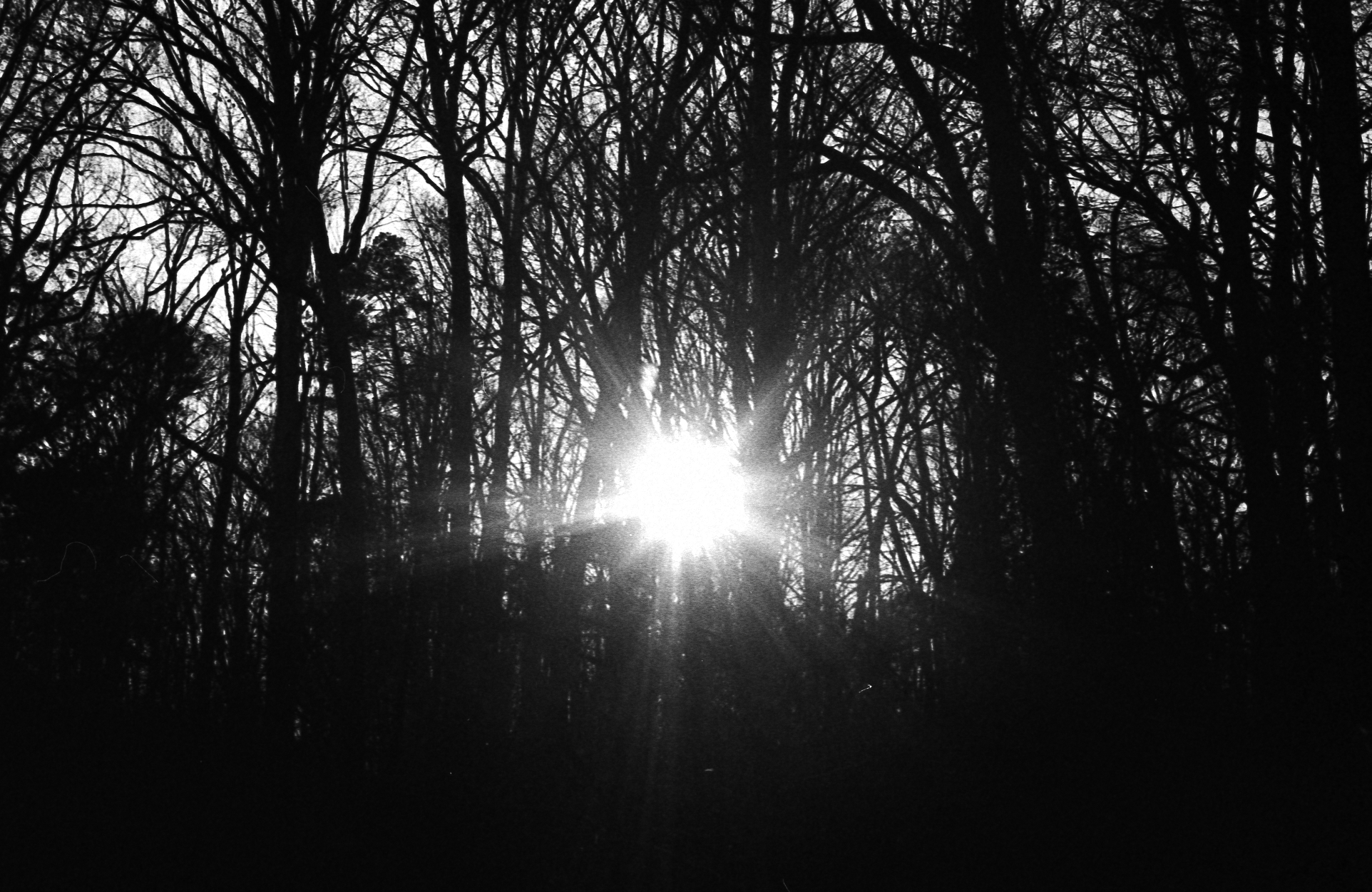
I have always wanted to make a photobook with the sun as its theme. I can no longer remember where the idea came from. Perhaps it began in dreams—I often dream of the sun drifting uncertainly before me. Maybe the sun sends dreams, too. This desire to make a photobook resurfaces on any day I can see the sun—that is, every day—whenever I notice it, only to be forgotten again. So today I’m writing it down, as a marker I can return to.
To make the book, I often photograph the sun—though only in the first few frames and the last few frames of each roll of film. The first frames are for advancing the film; the last are taken because I’m impatient to rewind and develop it. In short, it’s an unserious habit. I want to learn from Lee Friedlander—to collect what I want to collect through photography. Whenever he sees a STOP sign, he photographs it; whenever I notice the sun, I take a picture. Still, judging by how few of my photographs actually contain the sun, it clearly hasn’t captured my attention very well.
When I was very young—five or six—I drew on ceramics in a pottery shop inside a mall. Afterward, the shop would fire the piece so the drawing remained. I wanted to depict a sweltering summer, so I painted an orange circle and called it the sun. I also wanted to draw the way heat distorts vision—its wavering, shimmering—(I don’t know why I was thinking about things then that even now I can’t quite explain). But I couldn’t make myself understood, and even if I had, the staff couldn’t have helped. They took my intention to be simply “heat” and added red, spiky rays around my sun. I was dissatisfied. Perhaps I had already accepted realism too early: the sun, I felt, should not have that ring of rays. Even as a child, I sensed the shop was indulging a childish lie.
Only after I began photographing—after I had my own camera and figured out the exposure triangle—did I think those strokes might not have been wrong after all, because with a small aperture, the sun really does look like that.
I love Fernando Pessoa’s poetry, and I love his temperament. He liked inventing a crowd of names for himself, stepping into different roles to create distinct worldviews and styles, writing different kinds of poems. This resonates with my current philosophy of life: I want many identities, to do many things across many fields. But life is finite, and I am not Leonardo da Vinci; even if da Vinci were alive today, he might not amount to much.
Pessoa is different. Dreaming has no cost; writing poetry has no limit. And when he is a poet, he can also be a shepherd named Alberto Caeiro.
Caeiro loves fields, loves rivers, loves flowers—but what he loves most, without question, is the sun. Because when the world has a sun, grass is green and flowers are red; and when there is no sun, all colors become the color of shadow.