A friend was driving; I sat in the passenger seat. We didn’t enter the Donghai Bridge until after the sun had sunk into the sea. The window was half open. Wind battered my eardrums into a low roar, and because unfamiliar rock music was playing inside the car, we kept turning the volume up to fight it. Ahead stretched a bridge with no visible end, the night sliding from blue into black; behind us, wind turbines stood in regimented rows in the middle of the sea. Outside, the wind seemed fierce—blades nearly a hundred meters long spun wildly under its force, and as the light faded, the waves grew restless too. Perhaps because the bridge deck sat so high, or because our small car was the only one among hulking container trucks, driving there felt like walking a tightrope—trembling, unsteady—as if I were a sheet of paper that could be blown away at any moment, or an aluminum can that could be crushed without warning.
By the time we reached Yangshan Port, night had fully fallen. Our car felt like Jack lost in the land of giants, surrounded by container stacks piled like hills and colossal gantry cranes. Dim yellow streetlights, wire fencing, and dust kicked up by passing trucks gave the entire port a hazy look—lifeless, all iron and floodlights, pure industrial texture. There was a strange, artificial beauty to Yangshan at night, coupled with a sense of helplessness—like Silent Hill staged by Transformers (an odd description, but that was exactly the phrase forming in my head).
We pulled over. My friend took a tripod, a telephoto lens, and a drone out of the trunk, shooting containers through the fence. I didn’t have a telephoto, and the drone was acting up, so boredom crept in quickly. I slumped back into the passenger seat, sighing.
After tinkering with the drone for a while, my considerate friend—before my irritation could fully swallow me—packed the gear and got back in. We drove on, deeper toward the center of the island. Trucks were parked along the roadside; some drivers were bathing with plastic basins. I thought of the traffic jams every Spring Festival, and of the truck drivers stranded on highways during Shanghai’s lockdown. It felt like a rare chance to see their lives up close. I noticed one driver lift the hood of his truck and hang clothes on it with wire hangers. It struck me as ingenious. We pulled over, ready to talk.
Worried that walking up empty-handed might feel abrupt, I grabbed a box of egg tarts from the back seat—meant to be a late-night snack—and stepped out. Camera in my right hand, egg tarts in my left, I wandered toward the driver. Just as I was about to pass him and his truck, I stopped, turned, and said, “Sir, would you like an egg tart? My friend bought too many—we can’t finish them.” (I bought them, actually.)
He froze for a moment, then said, “Oh—sure,” and took one from me. I was hungry myself, so I pulled out another and ate it on the spot—hardly the behavior of someone who “couldn’t finish”—but he didn’t seem to mind. At least we’d started talking. He took out a cigarette and asked if I smoked.
“I don’t,” I said. “If I did, my dad would kill me.”
The driver was from Jiangsu. His wife and child now lived in Shanghai; his son was about our age, working too. Because of his job, he often couldn’t go home for ten days or more at a time. In terms of living space, the truck was more his home than anything else. As he put it, “I eat, drink, shit, and sleep in the truck.”
He showed us the interior: pots and pans, clothes, pillows—everything in place. From a spatial-efficiency perspective, it wasn’t unlike the compact living solutions the Japanese are known for, except that practicality far outweighed refinement. It wasn’t pretty, but it worked.
Using the hood as a clothes rack was pure genius. I couldn’t help thinking that Chinese truck drivers must have developed an entire system of habits and tricks—ways of carving out a livable world from limited space and time, wherever the road happens to take them.
He asked if we were college students. Students who came to Yangshan Port in the dead of night, he said, weren’t exactly common—but he also thought it was a good thing for young people to come see what “life” looks like. We nodded vigorously. Seeing our curiosity, he answered everything. We talked about the work of truck driving, the scale and construction of Yangshan Port, the places he’d driven long haul, the major accidents that had happened there.
In the end, half joking, half serious, I asked if he could hide us in the truck and drive us into the port. He waved his hand emphatically. “They’re very strict here. Last time I brought interns in, we got stopped and checked.” Seeing how firm he was, I dropped it. Before leaving, I asked to take his portrait.
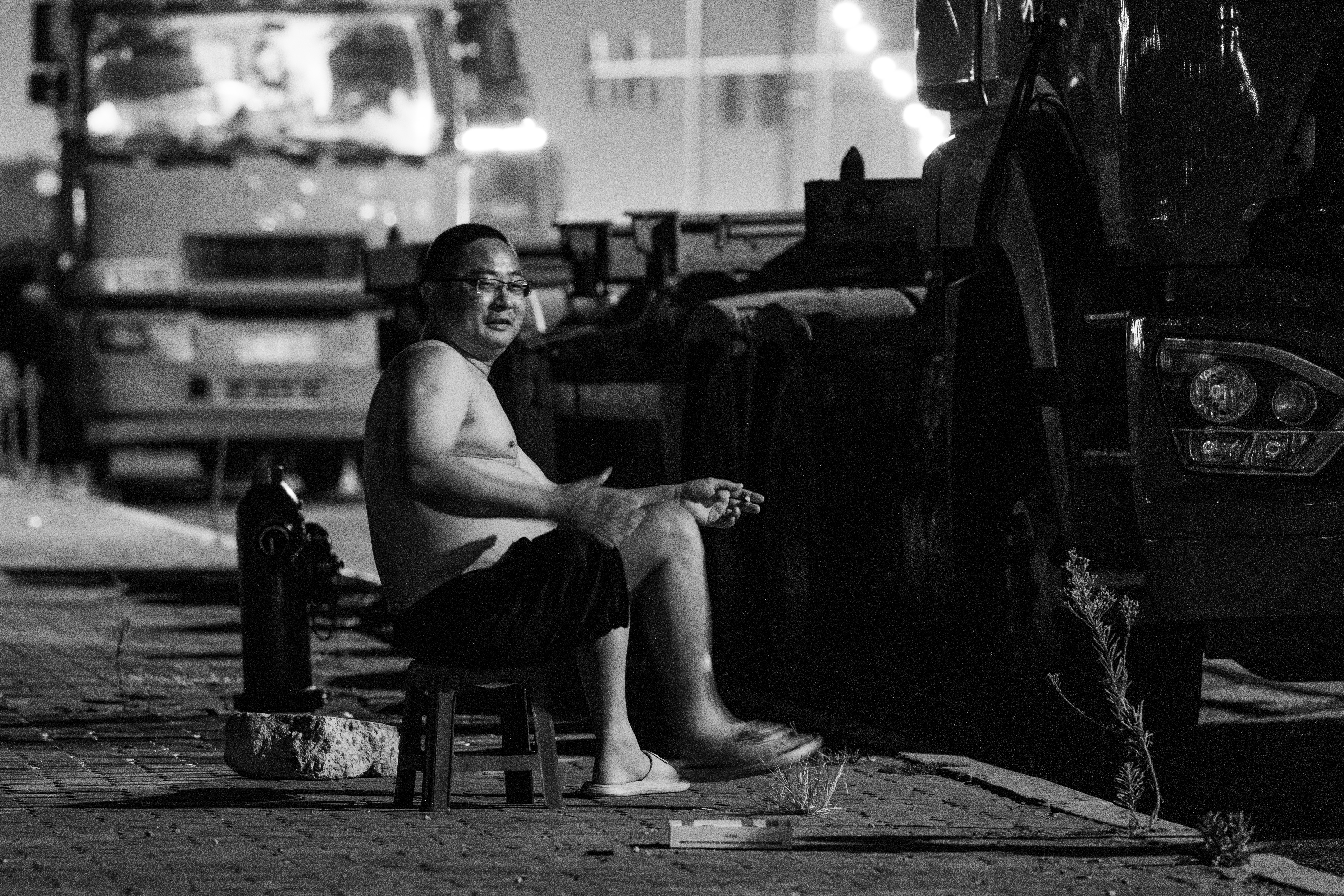
There he was, smoking amid the ever-present dust of Yangshan, scrolling on his phone. Three egg tarts sat by his stool, beside the truck that accompanied him day and night. Between the man and the machine was a bond that went beyond person and object—something like the intimacy between a Siamese war elephant and its rider: side by side, fighting together, depending on each other. It felt like a form of life I’d never encountered before, a strange local world existing—grotesque, unfamiliar—within the same city we all inhabit.
After that, my friend and I drove to the largest automated terminal to photograph cranes and container mountains. Less than thirty seconds later, security chased us off, throwing around phrases like “key facility” and “legal responsibility,” demanding signatures and photos. We ignored them, grabbed our gear, hustled back into the car, and sped away.
Returning to Dishui Lake felt like coming home from a foreign land. We still had some energy, so we tried to shoot the stars by the sea. Clouds ruined that plan. We took a few photos of the wave-breakers instead, just enough to convince ourselves the trip hadn’t been for nothing. In the end, we headed back in defeat, eating grilled cold noodles to fill the hollow left by the night snack we never really had.